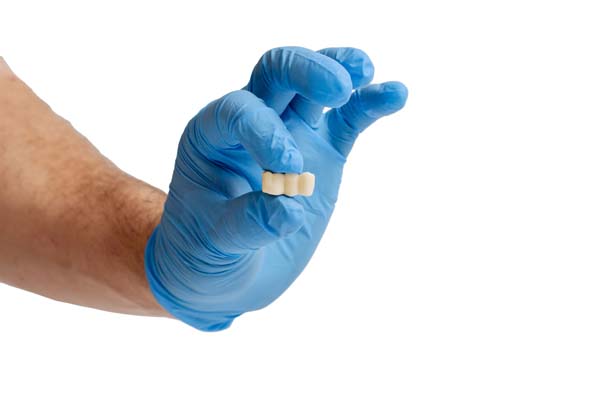
It is helpful to understand the different types of dental bridges to determine why your dentist may recommend a specific one. All dental bridges accomplish the same goal, which is to replace a missing tooth or a section of missing teeth. However, depending on the patient’s goals and the status of their oral health, a certain type of dental bridge may be preferable.
A review of the different types of dental bridges
The four main types of dental bridges are fixed bridges, cantilever bridges, Maryland bonded bridges, and implant-supported bridges. Although similar, there are small differences in the treatment processes for each one. This review discusses those processes and the benefits of the four types of dental bridges.
What is a dental bridge?
A dental bridge is a fixed dental restoration that replaces one or more missing teeth. There are two main components to a dental bridge: the bridge itself and the abutments. The abutments are natural teeth that are supported by dental crowns. However, a bridge can be supported by dental implants as well.
Fixed bridges
A fixed bridge is the most common type of dental bridge. This refers to a bridge that is supported by two abutment teeth. The abutment teeth exist on each side of the gap left by the missing teeth. Attached to the abutments are dental crowns, which ensure that the pontic teeth that make up the bridge have adequate support. A fixed bridge likely requires the dentist to remove some of the enamel on the abutment teeth to make room for the bridge. A fixed bridge can be applied to any tooth, including premolars and molars.
Cantilever bridges
A cantilever bridge is similar to a fixed bridge. However, the bridge is only attached to one abutment rather than an abutment on each side. Subsequently, cantilever bridges are less reliable than a fixed bridge, but they still should provide adequate support when they are recommended by a dentist. Of course, not every patient is eligible for a cantilever, depending on the status of their oral health and teeth replacement needs.
Maryland bonded bridges
Maryland bonded bridges, also called resin-bonded bridges, are most often applied to teeth in the front of the mouth that are more visible. They are held in place by metal or porcelain bands that are attached to the back of the abutment teeth. They are preferable for replacing front teeth because they do not require placing crowns on the abutment teeth. However, they are not nearly as durable as fixed bridges or cantilever bridges.
Implant-supported bridges
Implant-supported bridges are bridges that are held together by dental implants. With these types of dental bridges, the implants replace the abutment teeth. This is typically preferred when the patient does not have adjacent teeth that can support the bridge.
Schedule a consultation with our dental practice
If you would like to learn more about the different types of dental bridges, reach out to our dental practice today to arrange a consultation visit, during which we can discuss available treatment options.
Request an appointment here: https://www.pattersondentaloffice.com or call Patterson Family Dental at (209) 585-1472 for an appointment in our Patterson office.
Check out what others are saying about our dental services on Yelp: Dental Bridges in Patterson, CA.
Recent Posts
Looking for information on whether a dental crown or dental bridge is better for repairing damaged teeth? These two popular tooth repair options are commonly used to fix problem teeth. When it comes to which option should be used, it depends on the reason why each patient needs dental repair. Read on to find out…
If you have a missing tooth, it may be difficult to eat or speak. You may not even want to be around other people. Fortunately, you do not have to struggle with this condition for long. Your dentist can talk to you about a treatment to fill in the gap and replace the tooth so…
Knowing when to seek professional gum disease treatment helps preserve gum health, stop bone loss, and protect natural teeth. Early attention reduces inflammation before it spreads to the supporting bone, affecting chewing comfort. Gum disease, also called periodontal disease, starts when plaque hardens into tartar and irritates the gums. Over time, pockets form between the…
Patients often search for root canal treatment when a tooth aches from deep decay, a crack, or inflamed pulp tissue. This therapy removes irritated nerve tissue, disinfects the canal space, and seals the tooth to prevent reinfection. By preserving the natural root, the procedure maintains bite balance and chewing strength. With careful planning, a restored…